
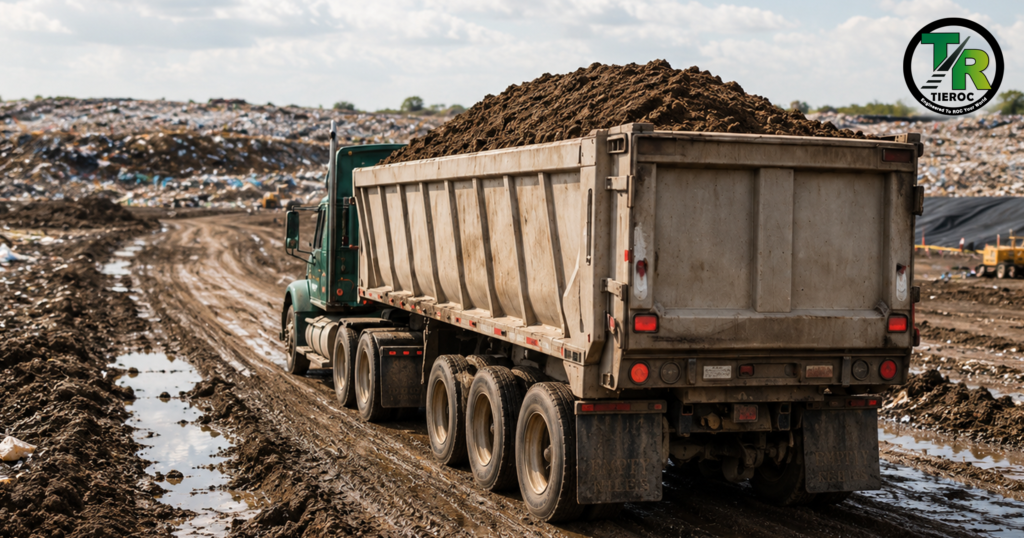
For many landfills, the biggest hurdle to switching ADC is not performance. It is freight.
The material may make sense. The compliance box may be checked. The operations team may even like the product. But then the real-world question shows up: who is paying to move it, and does the haul actually make economic sense?
That is where backhaul becomes a much more important part of the conversation.
The hidden cost problem is not just material price
When landfill teams compare ADC options, it is easy to focus only on the price per load. But that does not capture the full operating picture.
A more useful question is this: what does the delivered solution actually cost once you factor in empty return trips, demurrage delays, unloading wait time, weather slowdowns, and trucks getting stuck on soft or muddy surfaces?
Those costs add up fast, especially when conditions are wet and the working face is under pressure.
Why backhaul deserves a closer look
Backhaul works when a truck can avoid running empty on one leg of the trip.
In practical terms, that can mean using existing hauling patterns more efficiently, coordinating delivery around routes already being run, or working with regional material and hauling partners to reduce wasted miles. The goal is simple: improve delivered economics without creating another operational headache. For landfill operators, that matters because freight inefficiency can erase the value of a better cover strategy. Even a strong ADC program can become harder to justify if trucks are burning time in traffic, waiting to merge, sitting to unload, or charging for delays tied to poor site conditions.
Mud changes the economics more than people think
Anyone who runs a landfill in the Midwest knows wet weather is not a minor inconvenience.
Mud slows truck turnaround. It creates bottlenecks. It can increase the risk of stuck vehicles. It can force operators to pull equipment into recovery work that does not move tonnage or revenue.
If a hauler is getting billed time because the site is soft, slow, or backed up, the freight number on paper is no longer the real freight number. At that point, the question shifts from what the truck charges to what the site condition is costing every day.
ADC is not just about compliance
Alternative daily cover still has to do its job, but the best programs do more than check a box.
If your cover strategy also helps the site stay moving in ugly conditions, it is doing more than meeting a requirement. It is helping protect daily throughput.
That is part of the opportunity with a cleaner, more consistent ADC approach. The conversation becomes operational, not just regulatory.
What landfills should ask when evaluating backhaul for ADC
Before saying yes or no to a delivered ADC program, it helps to ask a few better questions:
1.) What is our real delivered cost, not just our load cost? Include idle time, wait time, demurrage delays, soft-ground delays, and any recovery work caused by wet conditions.
2.) Are we comparing the same amount of usable coverage? A cheaper-looking material is not necessarily cheaper if it delivers much less volume per dollar.
3.) How often are road and working-face conditions slowing trucks down? If weather regularly affects turnaround, that cost belongs in the comparison.
4.) Can a hauling partner build this into a more efficient route pattern? Backhaul only works if the logistics are disciplined.
5.) Are we buying a material, or are we buying operating efficiency? That is a very different calculation.
Why this matters now
As landfill operations get more complex and performance expectations rise, the economics around daily cover deserve closer attention.
If daily cover affects airspace, turnaround, site conditions, and broader operating efficiency, then the freight model behind that cover deserves real scrutiny too.
The takeaway
If your landfill is evaluating ADC and the freight line keeps killing the discussion, do not stop at the quoted haul rate.
Look at the full picture: empty miles, stuck trucks, demurrage, wait times, weather delays, and the amount of usable coverage you actually get for the spend.
That is where backhauls can become a smart operating lever, not just a transportation detail.
And when the material itself is clean, consistent, weather-resistant, and designed to deliver more coverage per dollar, the economics can start to look very different.
Want to evaluate whether a backhaul-based ADC delivery model could work for your site? Contact TIEROC for a cost comparison based on your location, current cover approach, and haul pattern.


